Every AI data center is a building full of copper, cooled by water, powered by electricity that someone has to generate. That story has been told a thousand times since ChatGPT launched on 30 November 2022: if AI is the gold rush, the metals are the picks and shovels. So we checked how the picks and shovels actually did.
Short answer: they did well. Just nowhere near as well as the chips. And the metal that did best wasn't the one most people would guess.
How did AI stocks and AI metals perform since ChatGPT launched?
We lined up five things on the same trading days from 30 Nov 2022 to 12 Oct 2026: Nvidia, the company most people picture when they think of AI; silver, which goes into electronics and solar panels; a fund of copper miners (COPX); a fund of uranium miners (URA), the nuclear-power bet on data-center electricity; and the S&P 500 as the yardstick.
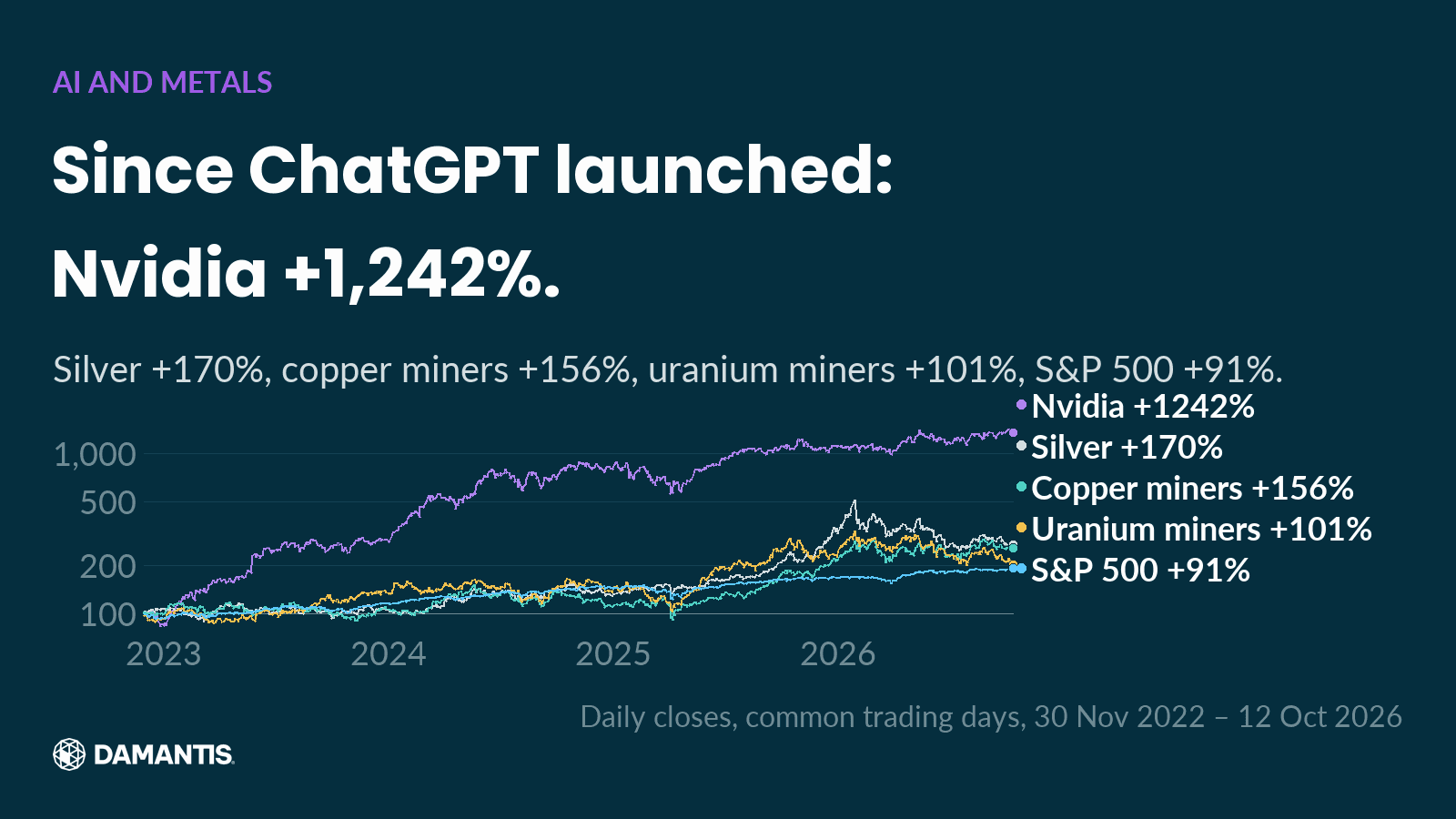
Nvidia rose +1,242%. That is the number everyone knows. The rest is where it gets interesting. Silver rose +170%, copper miners +156%, uranium miners +101%. The S&P 500 gained +91% over the same days.
So the picks and shovels beat the broad market, but not by the margin the story suggests. Uranium miners, the purest "AI needs power" trade, came out only a little ahead of the S&P 500. And silver, which rarely gets mentioned in AI pieces at all, beat both the copper and the uranium miners.
We find that worth sitting with for a moment. A narrative can be completely true (AI really does need enormous amounts of metal and power) and still be a poor guide to which asset benefits most. The demand story was right. The ranking was not what it predicted.
Is the AI metals trade riskier than the AI stocks?
Returns are half of the picture. The other half is how bumpy the ride was. For each of the five, we measured the largest drop from a previous high at any point since ChatGPT launched.
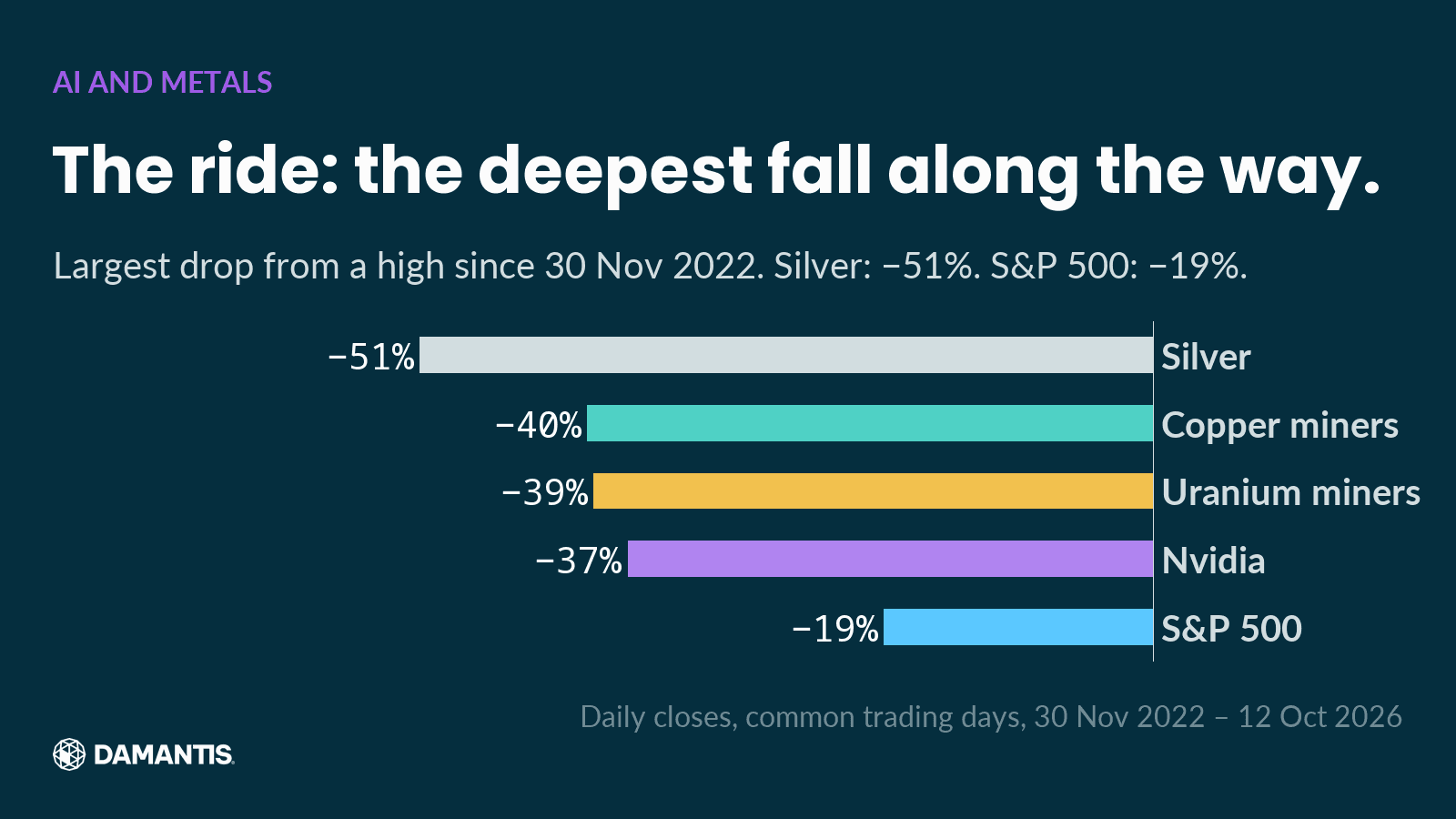
The deepest fall belonged to Silver: −51% from a high at one point. Nvidia's worst stretch was −37%, copper miners −40%, uranium miners −39%. Even the S&P 500 stood −19% from a high at one point along the way.
Silver is the surprise here too. It delivered a strong return and the deepest drop of the group. That is what commodities do: they carry real swings even in a good stretch. Anyone who held silver for this whole period needed the stomach for a fall of half its value on the way to the gain.
What happened to these stocks before the AI boom?
The AI story is only a few years old. The miners have been around far longer, and their history is worth knowing before anyone calls them a one-way bet. Here is the largest drop from a high for Nvidia, the copper miners and the uranium miners from 3 Jan 2017 to 12 Oct 2026.
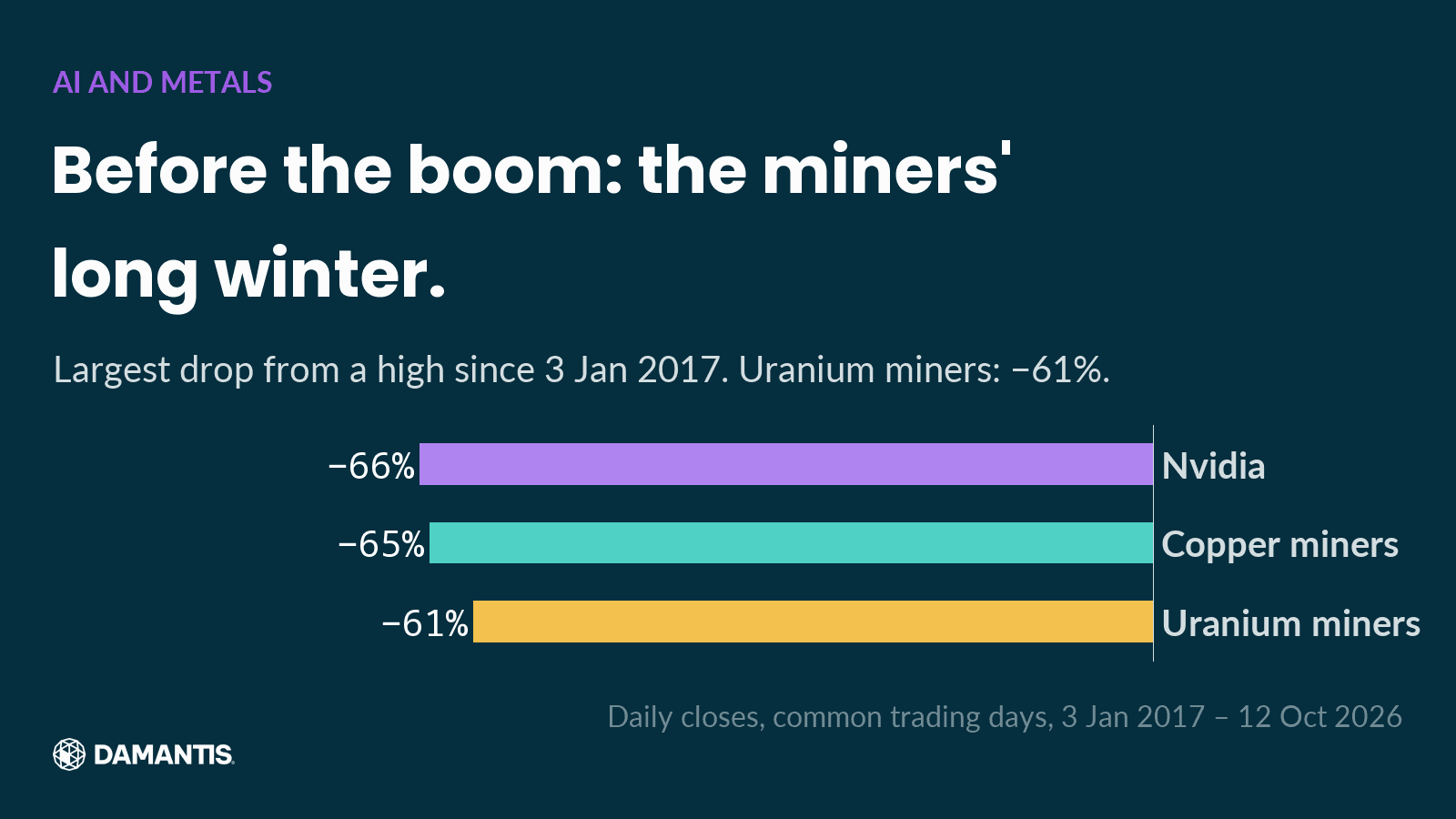
All three have been cut by roughly two thirds at some point: Nvidia −66%, copper miners −65%, uranium miners −61%. Nvidia included. The company at the center of the boom lost about two thirds of its value from a high within this period, before the run that made it famous.
That is the part of the AI trade that rarely makes the headlines. Mining stocks are leveraged to metal prices, and metal prices move in long cycles. A miner that rises in a boom can fall just as hard when supply catches up or demand cools. The same is true for the chips.
Why didn't the metals move like the chips?
The charts can't give the reasons, but they narrow down the questions. A chip company's revenue can grow many times over in two years when demand explodes, because it sells a scarce product at whatever price the market bears. A mining company is different. It sells a commodity at the market price, it needs years to open a new mine, and its costs rise with energy and labor. Higher demand helps, but it reaches the miners through the metal price, and the metal price also depends on supply, interest rates, the dollar and the rest of the world economy, not only on data centers.
Silver is a good example of how many forces sit behind one price. It is an industrial metal used in electronics and solar panels, and it is also a precious metal that investors hold when they worry about money. Its strong run since 2022 has more than one possible cause, and the chart can't separate them.
That is why we'd treat "AI needs metal X" as the start of a question, not the end of one. The demand side of the story is easy to tell. The supply side, and everything else that moves a commodity price, is where the surprises tend to come from.
How we built these charts
Nvidia, the copper miners fund (COPX) and the uranium miners fund (URA) are daily closing prices, adjusted for stock splits. Silver is the spot price in US dollars. The S&P 500 is the index level. All five are compared on the days on which all of them traded, starting on the day ChatGPT was released to the public.
Every chart shows its source and the last day of data on the image. The numbers in this text are not typed in by hand: they are computed from the same data as the chart next to them, and the article is only built if every number passes the same checks as our social posts. Those checks look for gaps in the data, implausible daily moves, one as-of date per chart, and stock splits that could distort a price history.
So is AI demand for metals real?
Yes, and nothing in these charts argues against it. Data centers need copper for power and cooling, and they need electricity, some of which may come from nuclear plants. What the charts question is the step from "demand is real" to "this asset will benefit most." Over the last few years, the market rewarded the companies closest to AI revenue far more than the companies digging the raw material out of the ground.
The same kind of gap appears when the S&P 500 is measured in gold instead of dollars: a very different story from the one in dollars. The lesson is the same. A popular narrative tells you what people believe. A chart of what actually happened, from a stated start date, tells you how that belief played out.
Frequently asked questions
How much did Nvidia rise since ChatGPT launched?
From 30 Nov 2022 to 12 Oct 2026, Nvidia rose +1,242%, based on daily closing prices adjusted for splits.
Did copper and uranium miners benefit from the AI boom?
Yes. Over the same period, copper miners (COPX) rose +156% and uranium miners (URA) +101%, compared with +91% for the S&P 500. Silver rose +170%.
Which AI-related asset had the deepest drop?
Since ChatGPT launched, Silver had the largest drop from a high, −51%. Nvidia's largest drop in the same period was −37%.
Are mining stocks a safe way to invest in AI?
Mining stocks follow metal prices, which move in long cycles. From 3 Jan 2017, copper miners fell as much as −65% and uranium miners −61% from a high. That is the history behind the current run.
How damantis looks at this
Every chart in this article was computed from market data, with its source and date on the image. No figure was typed in by hand. damantis applies the same discipline to its signals and model portfolio: risk first, data over narrative. See how it works at damantis.com.
Orientation, not investment advice. damantis does not recommend specific securities. Past performance is not indicative of future results. Investing involves risk of loss.