Everyone has a favorite inflation hedge. For some it's gold. For others it's Bitcoin, "digital gold" with a fixed supply. Others swear by real assets like oil and metals. In 2021 and 2022 the US ran a live experiment on all of them, when inflation went from a footnote to the main economic story. So we went back and checked what each hedge actually did.
The answer surprised us, and it will probably surprise a few people who have strong opinions on the subject.
What happened to inflation in 2021 and 2022?
In March 2021, US consumer prices were 2.7% higher than a year earlier. By June 2022 that rate had reached 9.0%. Over those fifteen months alone, the price level rose 11.3%. These figures come from the Bureau of Labor Statistics' consumer price index (CPI-U), as published by FRED.
That is the window we use for the first chart: from 31 Mar 2021 to 30 Jun 2022, the stretch when inflation climbed from an ordinary rate to its peak of this cycle.
Which assets protected against inflation in 2021 and 2022?
We compared seven candidates on the same trading days: a broad commodity fund (DBC), energy stocks (XLE), gold, the S&P 500, long-term US Treasuries (TLT), silver and Bitcoin.
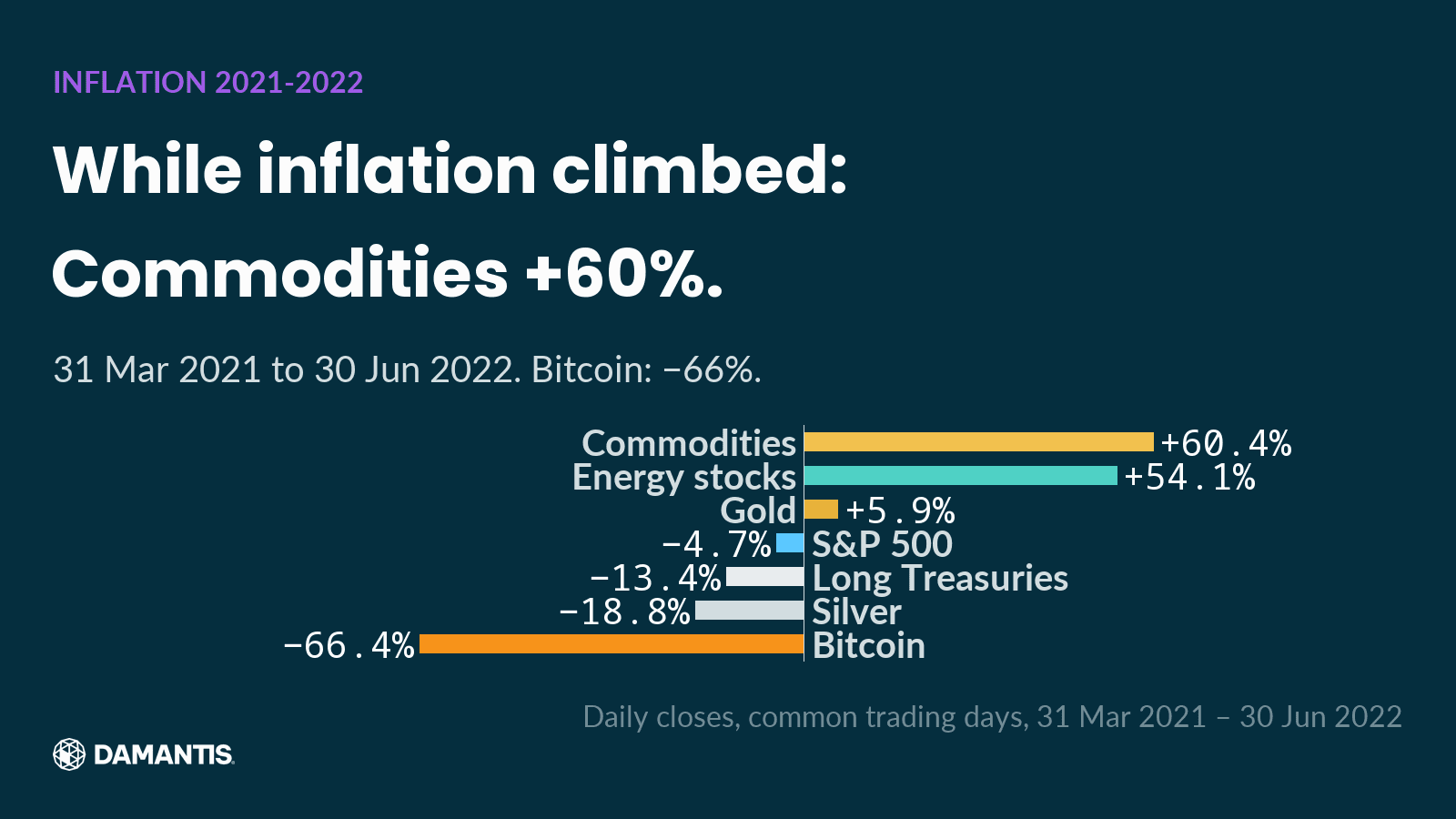
The winners were the obvious ones, if you think about where inflation came from. Broad commodities rose +60% and energy stocks +54%. Prices at the pump and on the grocery shelf were going up, and the assets tied directly to those prices went up with them.
The rest is where the stories fall apart. Gold, the classic inflation hedge, gained +6%. That is positive, but it is less than the 11% rise in consumer prices over the same months. The S&P 500 ended at −5%. Long-term Treasuries ended at −13%, because rising inflation brought rising interest rates. Silver: −19%.
And Bitcoin, the asset most often promoted as protection against money printing, ended at −66% while inflation was climbing.
Is gold a good inflation hedge?
Over this window, not a strong one. It held its value roughly, but it did not keep up with consumer prices, let alone match commodities. Seen from a longer angle, gold has spent most of its trading days since 1980 well below its last record. Gold may be many things. A reliable short-term hedge against a sudden inflation spike was not one of them in 2021 and 2022.
Is Bitcoin an inflation hedge?
The data from this period says no. When inflation rose fastest, Bitcoin fell the most of all seven assets. That doesn't settle every argument about Bitcoin over decades, but it does show what happened in the one real test it has faced so far. When rates rose, investors cut risk, and Bitcoin behaved like a high-risk asset rather than a safe one.
What worked over the whole inflation era?
A fifteen-month window can be misleading, so we also looked at the full stretch from the end of 2020 to today. Over that time, the US price level rose 27.5%. Inflation has since come down to 3.4% a year in the latest reading, but prices stay at the higher level.
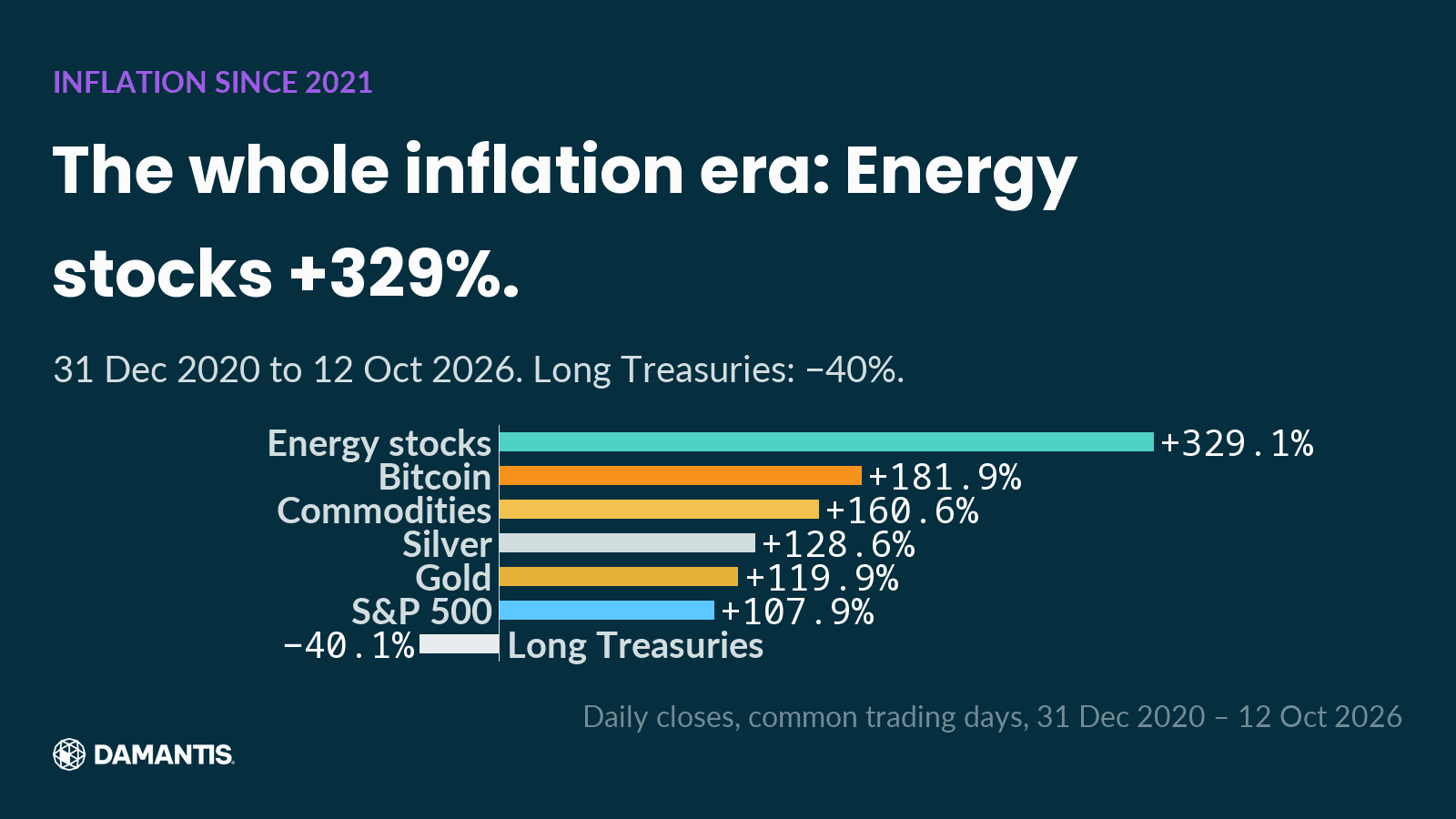
Over the full period, Energy stocks led with +329%. Broad commodities gained +161%, Bitcoin +182%, silver +129%, gold +120% and the S&P 500 +108%. All of them beat the 28% rise in consumer prices. Long-term Treasuries did not: −40%.
Two things stand out. First, the assets that failed during the spike, like Bitcoin and silver, recovered strongly later. Second, the asset many investors think of as the safe one, long-term government bonds, was the only one that lost money in a period when consumer prices rose 28%.
Why did commodities work when gold didn't?
The difference comes down to what each asset actually is. A broad commodity fund holds futures on oil, natural gas, metals and crops, the very things whose prices make up a large part of the inflation numbers. When those prices rise, the fund rises with them almost by definition. Energy companies earn more when the price of what they sell goes up, so their shares followed.
Gold is different. It doesn't go into the inflation basket, and its price depends on what investors are willing to pay for it as a store of value. In 2021 and 2022 that depended heavily on interest rates: as rates rose, holding a metal that pays no interest became less attractive compared with bonds and savings accounts. The same pressure hit Bitcoin far harder.
How we built these charts
All seven assets are daily closing prices from a commercial market data provider, compared on the days on which all of them traded. The funds (DBC, XLE, TLT) include dividends. Gold and silver are spot prices in US dollars. Inflation is the year-on-year change in the consumer price index for all urban consumers (CPI-U), seasonally adjusted, published by the Bureau of Labor Statistics and taken from FRED. The first chart ends on the last trading day of June 2022, the month inflation peaked.
Every chart shows its source and the last day of data on the image. The numbers in this text are not typed in by hand: they are computed from the same data as the chart next to them, and the article is only built if every number passes the same checks as our social posts. Those checks look for gaps in the data, implausible daily moves, one as-of date per chart, and stock splits that could distort a price history.
What does this mean for inflation hedges?
An inflation hedge is only a hedge if it works when inflation actually shows up. In the 2021–2022 test, the assets that did that were the ones directly tied to the things getting more expensive: commodities and energy producers. Gold held up but lagged. Bitcoin and silver fell first and recovered later. Long bonds were hurt at both stages.
The habit we'd take from this is to ask two questions of any hedge: does it rise when the problem appears, or only years later? And what does it do in between?
Frequently asked questions
What was the highest US inflation rate in 2022?
In June 2022, US consumer prices were 9.0% higher than a year earlier (CPI-U, Bureau of Labor Statistics via FRED).
Which assets did best during the 2021–2022 inflation spike?
From 31 Mar 2021 to 30 Jun 2022, a broad commodity fund (DBC) rose +60% and energy stocks (XLE) +54%. Gold gained +6%.
Did Bitcoin protect against inflation?
Not during the spike. From 31 Mar 2021 to 30 Jun 2022, Bitcoin's return was −66%, the largest loss of the seven assets we compared.
Did bonds protect against inflation?
No. Long-term US Treasuries (TLT) returned −13% during the spike and −40% from 31 Dec 2020 to 12 Oct 2026.
How damantis looks at this
Every chart in this article was computed from market data, with its source and date on the image. No figure was typed in by hand. damantis applies the same discipline to its signals and model portfolio: risk first, data over narrative. See how it works at damantis.com.
Orientation, not investment advice. damantis does not recommend specific securities. Past performance is not indicative of future results. Investing involves risk of loss.