Sequence of returns risk, counted: across all 69 start years since 1928, $1,000,000 all in the S&P 500 with 4% a year raised with inflation ran out within 30 years 5 times; the worst, 1929, ran out after 22 years. The rule held most of the time, but not for everyone: the person who retired in January 2000 had $127,994 left at the end of 2025, the one who retired in January 2008 had $3,085,383 (18 years of withdrawals against 26). Same rule, same index. The difference is the order of the years.
That order has a name: sequence of returns risk. It sits behind the questions people close to retirement ask most: what happens if I retire in a bear market, does the 4% rule still work, what if the market crashes the year I retire. The idea has been studied for thirty years, from William Bengen's first paper to the retirement calculators online. Here is our own count, with every start year in the record and the two cohorts most people remember.
What is sequence of returns risk?
Two retirees can earn the same average return and end up with very different amounts. While someone is still adding money, a bad year early on hurts little. Once money is being taken out, a bad year early on forces a retiree to cash in more shares at low prices to pay the same bills. Those shares are gone when the market recovers.
The rule we tested is the classic one, described by Bengen in 1994: take 4% of the starting amount in the first year, $40,000 on $1,000,000, and raise that amount with inflation every year after, whatever the market does. The rest stays in the S&P 500 with dividends reinvested, or in a 60/40 mix of stocks and 10-year Treasuries, rebalanced once a year. We use the yearly returns published by Professor Aswath Damodaran at NYU Stern.
Our version is a little stricter than Bengen's: the money is taken out at the start of each year, the bond half is the 10-year Treasury rather than a mix of intermediate bonds, and the raise follows each year's consumer price inflation. That is why our 60/40 mix runs out in a few more start years than his studies show.
What happened to people who retired in 2000 and 2008?
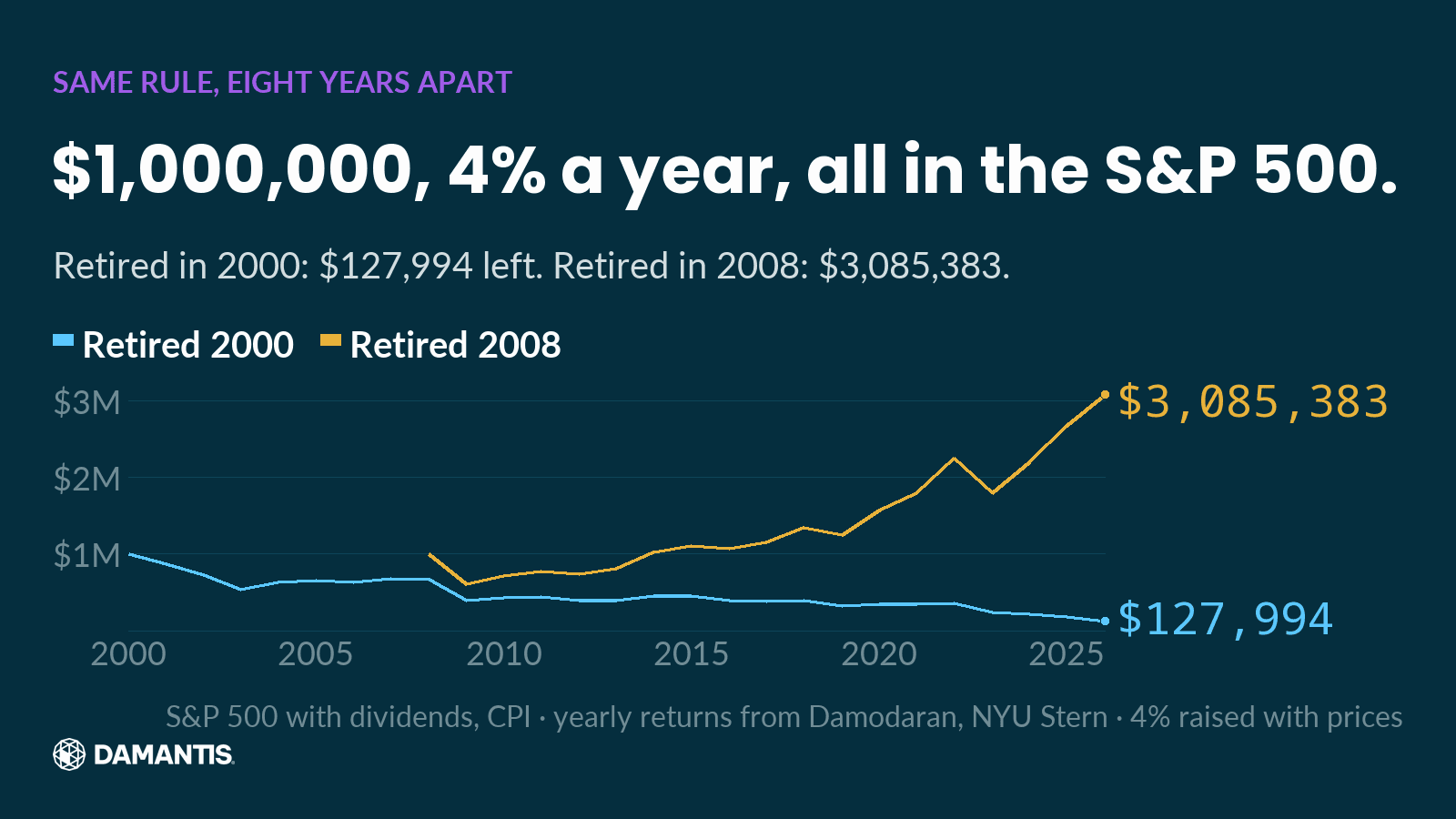
The 2000 retiree met 3 falling years in a row right away, and kept taking a rising amount out of a shrinking pot. By the time the market recovered, much of the money that could have recovered with it had been spent. The 2008 retiree took one terrible year, then had a long rise while the withdrawals were still small against the pot.
All figures are at the end of 2025, in 2025 dollars, with the value in start-year dollars beside them:
- Retired in 2000, all in the S&P 500: $127,994 left after 26 years of withdrawals (about $66,437 in 2000 dollars). That is 1.7 years of that year's withdrawal, which had grown to about $75,010.
- Retired in 2000, 60/40: $1,249,052 (about $648,339 in 2000 dollars).
- Retired in 2008, all in the S&P 500: $3,085,383 after 18 years (about $1,998,666 in 2008 dollars).
- Retired in 2008, 60/40: $2,032,882 (about $1,316,872 in 2008 dollars).
Starting in a crash year was not the worst case. Starting near a peak, before a weak decade, was.
How often did the 4% rule run out of money?
We took every start year from 1928 to 1996, 69 in all, each with 30 complete years of history.
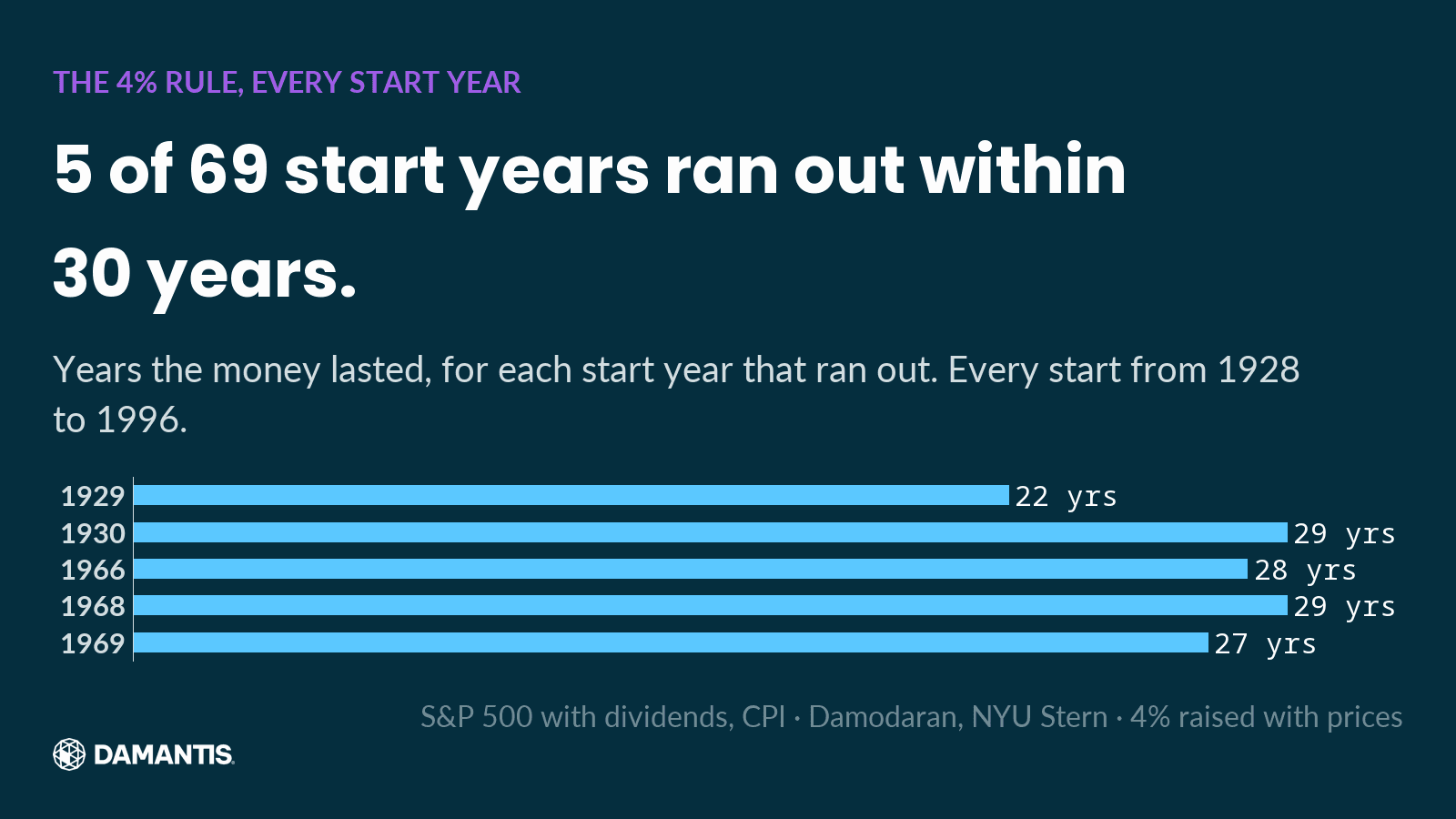
- All in the S&P 500, the money ran out within 30 years for 5 of the 69 start years (7%): 1929, 1930, 1966, 1968, 1969.
- In a 60/40 mix, it ran out for 4: 1965, 1966, 1968, 1969. The shortest of those lasted 26 years.
- The median start year ended 30 years later with $10,295,540 in stocks (about $4,050,790 in start-year dollars) and $4,533,961 in 60/40 (about $1,387,870).
So the rule held in most of history, and the typical retiree ended with more than they started with, even after inflation. The failures cluster in two places: the start of the Great Depression and the late 1960s, when a weak decade for stocks met high inflation that kept pushing the withdrawals up.
The person who retired in 1966 is the textbook case. All in stocks, the money ran out in 1993; in 60/40, in 1991.
Is a 5% withdrawal rate safe?
One percentage point changed a lot. At 5% a year, raised with inflation, the money ran out within 30 years for 15 of the 69 start years in stocks, against 5 at 4%, and for 19 in 60/40, against 4. We counted six different amounts a year on the same $1,000,000 in is $1 million enough to retire?.
Do the first years of retirement decide whether the money lasts?
The first decade does more than the first three years. In 7 start years the S&P 500 lost more than 20% after inflation in the first three years (1929, 1930, 1939, 1940, 1946, 1972, 1973). 5 of those 7 still lasted the full 30 years; the market recovered with decades to spare.
The late-1960s retirees who ran out did not have a crash at the start. They had a decade that went nowhere while prices rose. After inflation, the S&P 500 returned −20.7% in the first ten years for the 1966 retiree, −21.9% for 1968 and −27.9% for 1969. The 1965 retiree, whose 60/40 money ran out, had −31.7%. We counted every ten-year span of stocks after inflation in have stocks ever lost money over 10 years?.
All in stocks, the median first decade after inflation was −20.7% for the cohorts that ran out, against +121.6% for those whose money lasted. The two Depression cohorts are the exception: prices fell in the 1930s, so their first decade was not negative after inflation, but the crash at the very start took too much.
Why does this matter 5 to 15 years before retirement?
Because the decade around the retirement date carries the most weight, and nobody can pick it. Someone who retired in January 2000 had just lived through a decade-long boom. Nothing in their account statement said the next 3 years would all be negative.
The same is true of the mix. In 2000, bonds rose while stocks fell, and the 60/40 retiree had $1,249,052 at the end of 2025, about $648,339 in 2000 dollars, below the start after inflation. We also counted what a crash does to a 401k and what moving to cash after one cost.
Where do we stand?
The record says the risk sits in the first decade of retirement and in the years just before it. We do not think the 4% rule is broken, and we do not think it is a promise. It is a summary of history, and history includes 1929, 1966 and 2000. What we watch is the market around those years: how stretched it is and how many stocks are already falling while the index looks calm.
None of this is a withdrawal rate for anyone's own money. It is every start year on record, so you can check it.
Once a week we send the Damantis Extremes Index: how many US stocks sit at extremes, against a normal week and the record. Get the weekly email
Frequently asked questions
What happened to people who retired in 2000?
With $1,000,000 all in the S&P 500 and 4% a year raised with inflation, $127,994 was left at the end of 2025, about $66,437 in 2000 dollars. In a 60/40 mix of stocks and 10-year Treasuries, $1,249,052.
Does the 4% rule still work?
In the record since 1928, with 4% of the start raised with inflation each year, 30 years, all in the S&P 500, the money ran out for 5 of 69 start years (7%). In 60/40 with 10-year Treasuries, 4. At 5%, 15 and 19.
What is the worst year to retire?
In this record, the start years that ran out in stocks were 1929, 1930, 1966, 1968, 1969. The 1929 retiree ran out after 22 years; the 1966 retiree in 1993.
Is it bad to retire in a bear market?
Not always. The 2008 retiree, who started in the year of the financial crisis, had $3,085,383 by 2025. The harder case was retiring near a peak before a weak decade, as in 2000 and 1966.
What is sequence of returns risk in simple terms?
The order of the returns matters once money is being taken out. The same average return with the bad years first leaves less money than with the bad years last.
How DAMANTIS looks at this
Every chart in this article was computed from market data, with its source and date on the image. No figure was typed in by hand. Once a week we send the same kind of count for the whole US market: the Damantis Extremes Index, how many US stocks sit at extremes, against a normal week and the record. One email, no daily noise. Get the weekly email
Education, not investment advice.