DAMANTIS Blog
Is a recession coming? Stocks peaked first in 8 of 11 since 1953
Nov 26, 2026
The word is back in the news, and you open the 401k before breakfast, read one more forecast and feel no wiser than before. The dread is rarely about the economy: it is the sense that the answer always comes after the damage.
In 8 of the 11 US recessions since 1953, the S&P 500 set its high months before the recession began, a median 9 months earlier. In the other 3, it peaked in the recession's first month. From that high it fell a median 27%, and 57% around 2007.
The usual answers to "is a recession coming?" are forecasts: an indicator, a probability, a date. Each one is a guess about the economy.
We asked a different question. Every recession since 1953 is already dated, so we can count what the stock market did around each one. The dates are the official ones from the National Bureau of Economic Research (NBER), the group that decides when US recessions begin and end. A recession starts here on the first day of the month NBER names as its peak. The S&P 500's high is its highest daily close in the two years up to the end of that first month. Prices are daily closes, without dividends. Counted on monthly closes, or from the recession's first day only, the split comes out differently: the high sits inside the first month in some cases.
Do stocks fall before a recession?
Almost always, yes. The chart shows how many months passed between the S&P 500's high and the month each recession began.
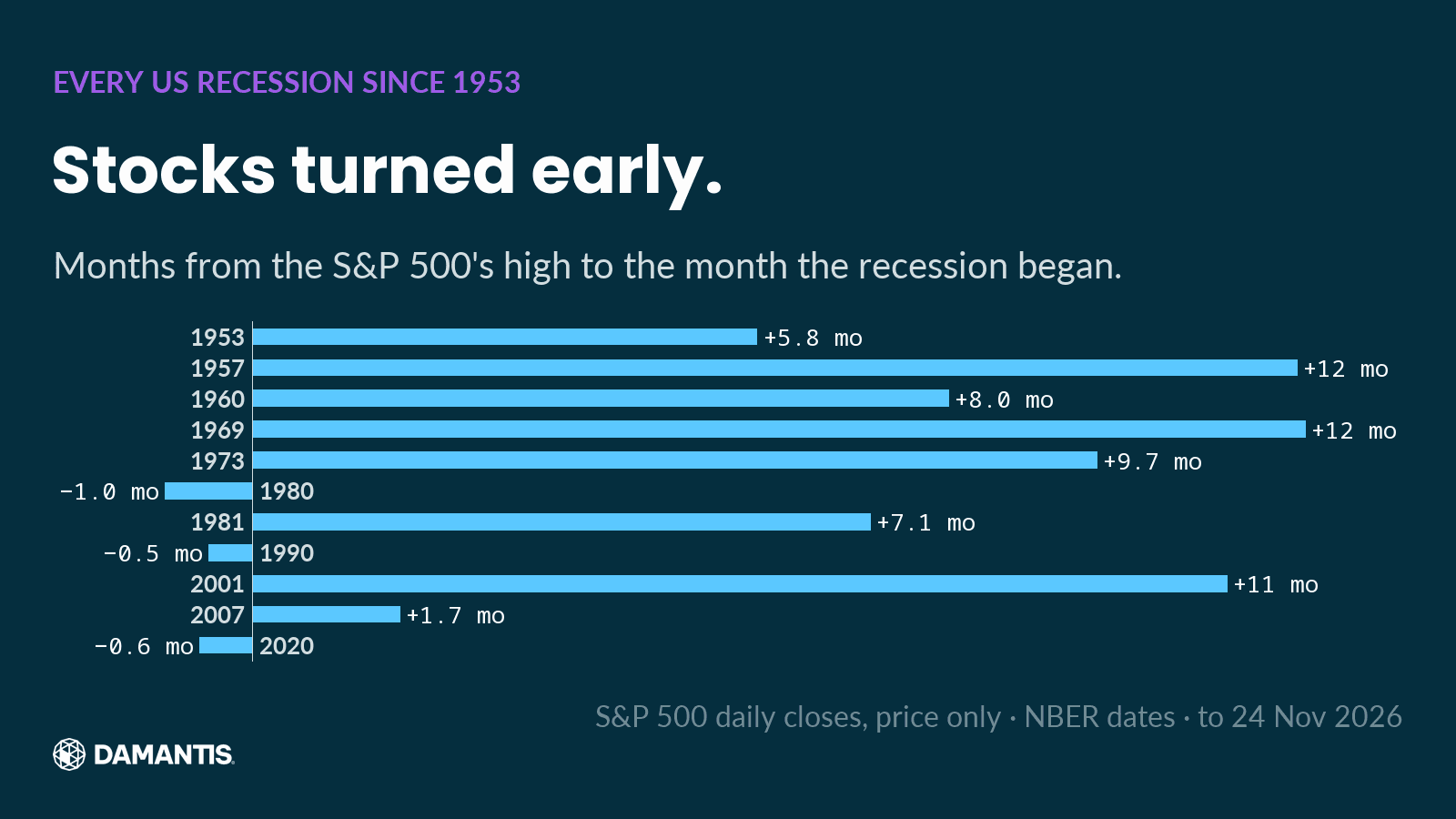
- In 8 of 11 recessions, the high came before the recession's first month. The longest lead was 12 months.
- In the other 3, the high came inside that first month: 1980, 1990 and 2020. In 2020 the record close came on 19 February, in the month the recession is dated from.
- On the last trading day before each recession began, the S&P 500 was already below its highest close of the two years before, in 11 of 11 cases, by a median 7%.
In 8 of 11 it moved first. In the rest it turned within 4 weeks of the start.
The reverse does not hold. Since 1953, the S&P 500 had 11 falls of 20% or more from a record. A recession began during 7 of them. The other 4 came without one: the falls from the records of Dec 1961, Feb 1966, Aug 1987 and Jan 2022. A falling market is not proof that a recession is coming. What we watch instead is the breadth of the fall: how many US stocks sit at a one-year low every trading day, in the Damantis Extremes Index.
How much did the S&P 500 fall in recessions?
Here is the fall from that high to the lowest close, up to a year after each recession ended.
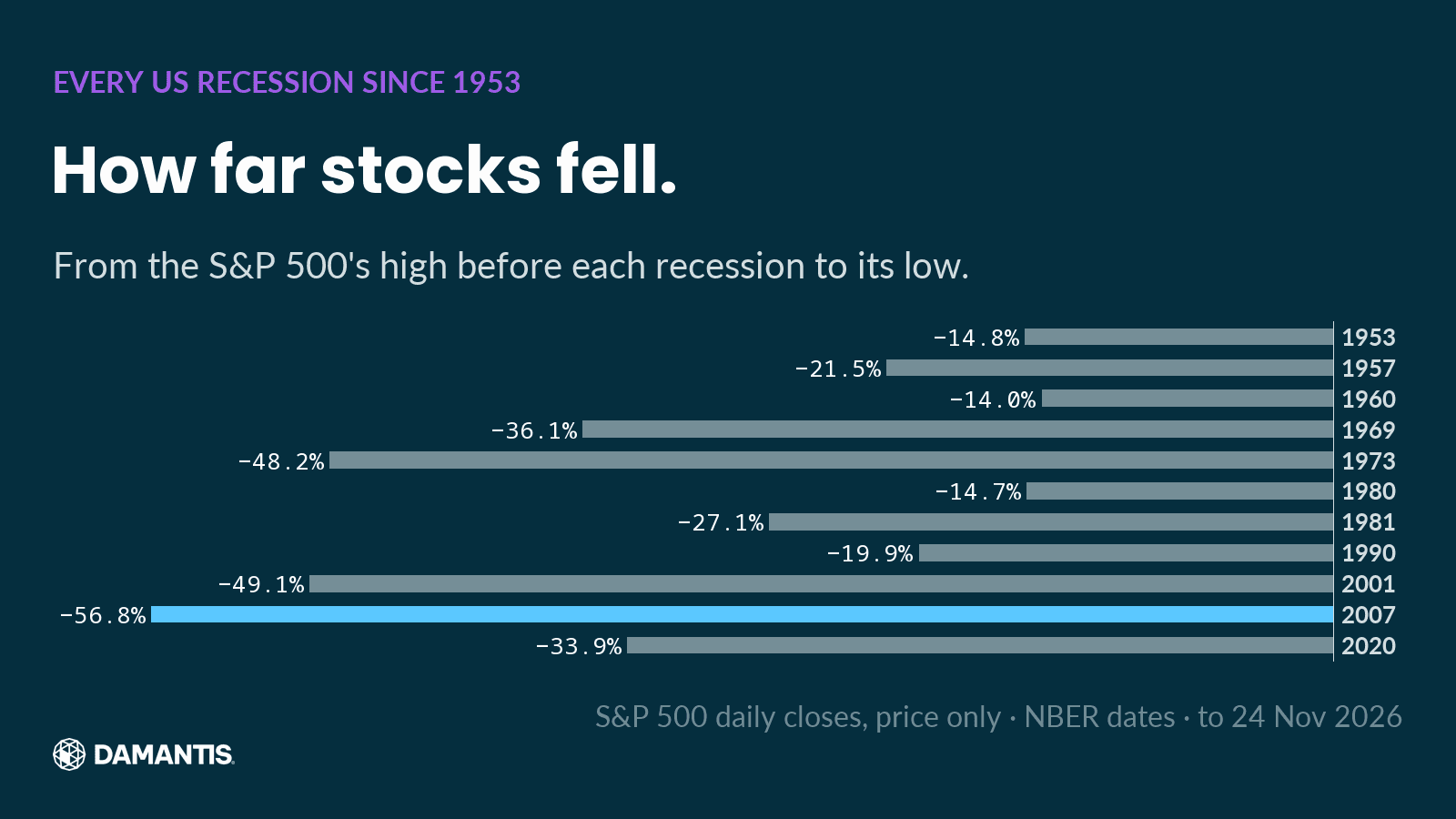
- The median fall was 27%.
- In 7 of 11 recessions the fall reached 20% or more, the line most people call a bear market.
- The worst was 57%, around the recession that began in 2007. Next came 49% around the recession that began in 2001 and 48% around the one that began in 1973.
- The mildest were the recessions that began in 1960, 1980 and 1953, with falls between 14% and 15%.
- Around 1990 the fall stopped at 19.9%, just short of the 20% line.
Here is the part the forecasts leave out. The stock market started falling early, but the worst of it came later. In all 11 cases the low came after the recession had begun, a median 6 months in. Once, around 2001, it came after the recession had already ended.
What did stocks do in the year after a recession began?
The chart shows where the S&P 500 stood a year after each recession began: from the last close before the recession's first month to the last close on or before its one-year anniversary.
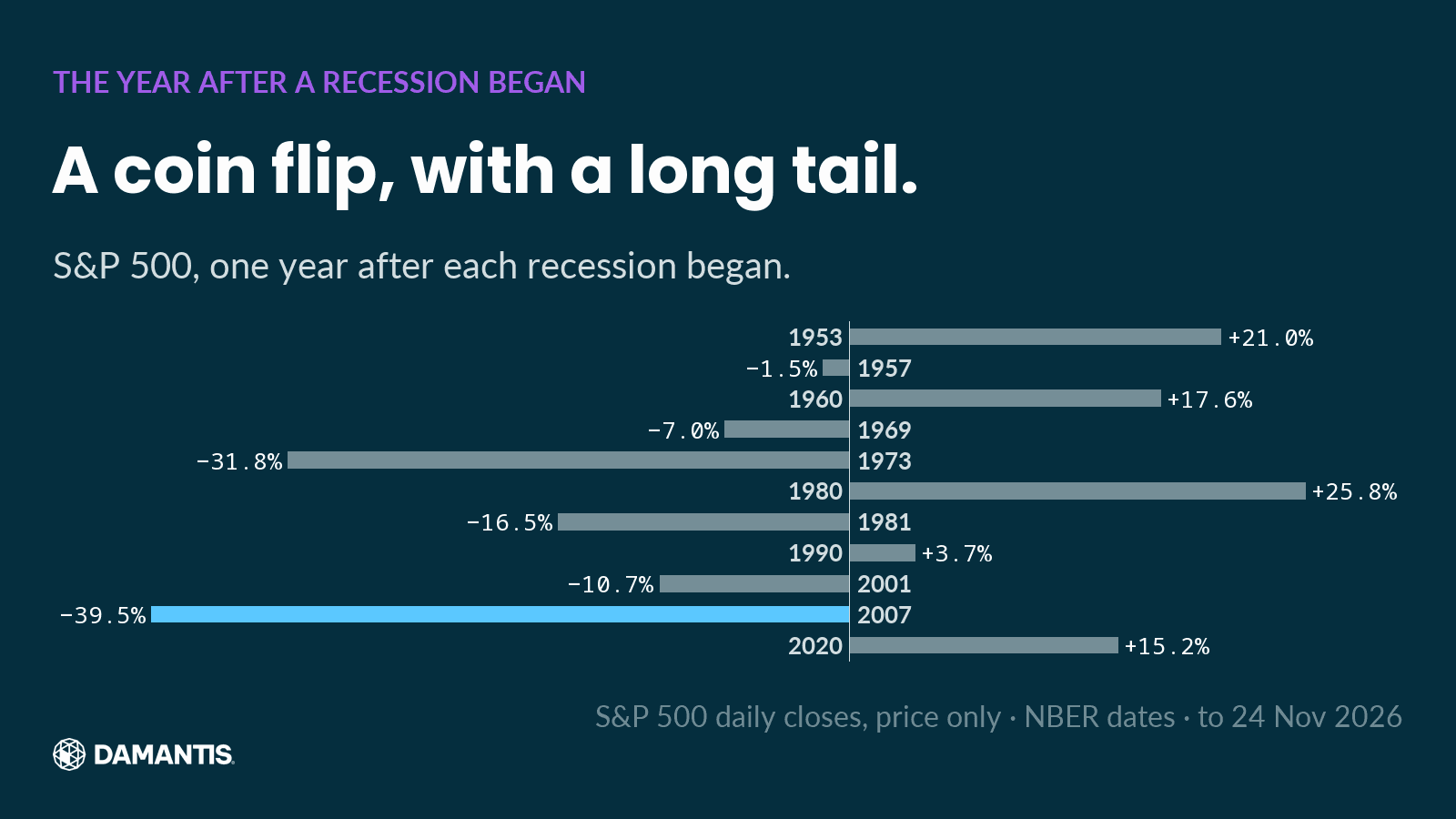
It was higher in 5 of 11 cases. The median was −2%, close to flat. The worst was −39.5%, in the year after December 2007.
That is the uncomfortable truth about recessions and stocks. By the time a recession begins, the stock market has usually fallen already. What comes next splits in two: a quick rebound in some, a much deeper fall in others. Nobody knew in advance which one it would be.
How long after a recession starts is it announced?
Months later. The NBER dates a recession only once the data is clear, and it says so in a public announcement. Since 1980 it has announced 6 recessions. The announcement came a median 8 months after the recession began, and 12 months after it in 2007.
By the day of each announcement, the S&P 500 stood a median 10% below its high. In 3 of 6 cases the low was already behind it. In the others the worst was still to come.
So "is a recession coming?" is often answered only after it has already started, and after the stock market has already moved.
How long did stocks take to recover after a recession?
From the high before each recession to the first close above it again, the S&P 500 took a median 23 months. The longest was 7.5 years, from the high before the 1973 recession. These are prices only. We counted every bear market, and how long each took to get back to its record, in how long do bear markets last?.
For an investor 5 to 15 years before retirement, that range is the point. The recession of 1960 cost 14% and was back in 18 months. The one of 2007 cost 57%, and the one of 1973 took 7.5 years to get back. Both started the same way.
What does a recession do to a 401k?
A recession does not hit a 401k on the day it is announced. The stock funds move before, during and after it, and mostly before anyone calls it a recession.
That is why the two harder questions are not about the economy. They are about what happens inside the account: how much of it is in a few large stocks, and what happens if money has to come out in the middle of a fall. We counted the second one for every crash in what happens to your 401k in a crash, and what leaving for cash cost in moving your 401k to cash after a crash.
Where do we stand?
On 24 Nov 2026, the S&P 500 closed 8% below its record of 6 Oct 2026. Whether a recession is starting, nobody can say today. If one is, the record says the official date arrives months later, and in past recessions the stock market did not wait for it.
That is what wears people down: waiting for an answer that arrives after the move. We built Damantis so that the waiting is not the plan. Every Trends signal is published in advance with its entry, target and stop, and the public record follows each one to its end, the losses included. Momentum sends a daily email when a stock enters the top 10 and when it drops out. The rules are written while the market is calm, so on the loud days there is less to decide and less reason to refresh the screen. It does not make a recession smaller. It makes it quieter to live through.
None of this tells anyone what to do with their own money. It is every case, so you can check it.
Once a week we send the Damantis Extremes Index: how many US stocks sit at extremes, against a normal week and the record. Get the weekly email
Frequently asked questions
Does the stock market fall before a recession?
In 8 of 11 US recessions since 1953, the S&P 500 set its high months before the recession began, a median 9 months. In the other 3, it peaked in the recession's first month.
How much does the stock market drop in a recession?
From its high to its low, the S&P 500 fell a median 27% around the 11 recessions since 1953. The worst was 57%, around 2007. Prices only.
Is the stock market a recession indicator?
It was already below its two-year high when each of the 11 recessions began, and peaked months earlier in 8. But not every fall meant a recession. Of the 11 falls of 20% or more from a record since 1953, 4 came without one: the falls from the records of Dec 1961, Feb 1966, Aug 1987 and Jan 2022.
How long after a recession starts is it announced?
Since 1980, the NBER announced the start of a recession a median 8 months after it began, and 12 months after in 2007.
Do stocks go up or down during a recession?
The S&P 500 was higher a year later in 5 of 11 cases, with a median of −2% and a worst case of −39.5%.
How DAMANTIS looks at this
Every chart in this article was computed from market data, with its source and date on the image. No figure was typed in by hand. Once a week we send the same kind of count for the whole US market: the Damantis Extremes Index, how many US stocks sit at extremes, against a normal week and the record. One email, no daily noise. Get the weekly email
Education, not investment advice.