DAMANTIS Blog
How long do bear markets typically last? Every one counted
Nov 24, 2026
How long do bear markets typically last? Since 1950, the S&P 500 had 11 bear markets, falls of 20% or more from a record close, and the old record came back after a median 2.0 years. 5 of 11 were back within two years. 3 took more than five: the falls from the 1973, 2000 and 2007 records. The Nasdaq-100 was quicker: 7 of its 8 bear markets since 1985 were back within about two years. Once it took 15.6.
Searches for "how long do bear markets typically last" broke out in US Google Trends over the past month, next to "will the stock market recover". The answers that rank give one average and a reassuring line. An average hides the only thing that matters to someone who needs the money soon: whether this fall is one of the short ones or one of the long ones.
So here is every case, one by one. No average without the list behind it.
How long do bear markets typically last?
There are two clocks. One runs from the record close to the lowest close. That is the fall. The other runs from the record to the day the index closes above that record again. That is the wait, and it is the one people mean when they ask "will it come back".
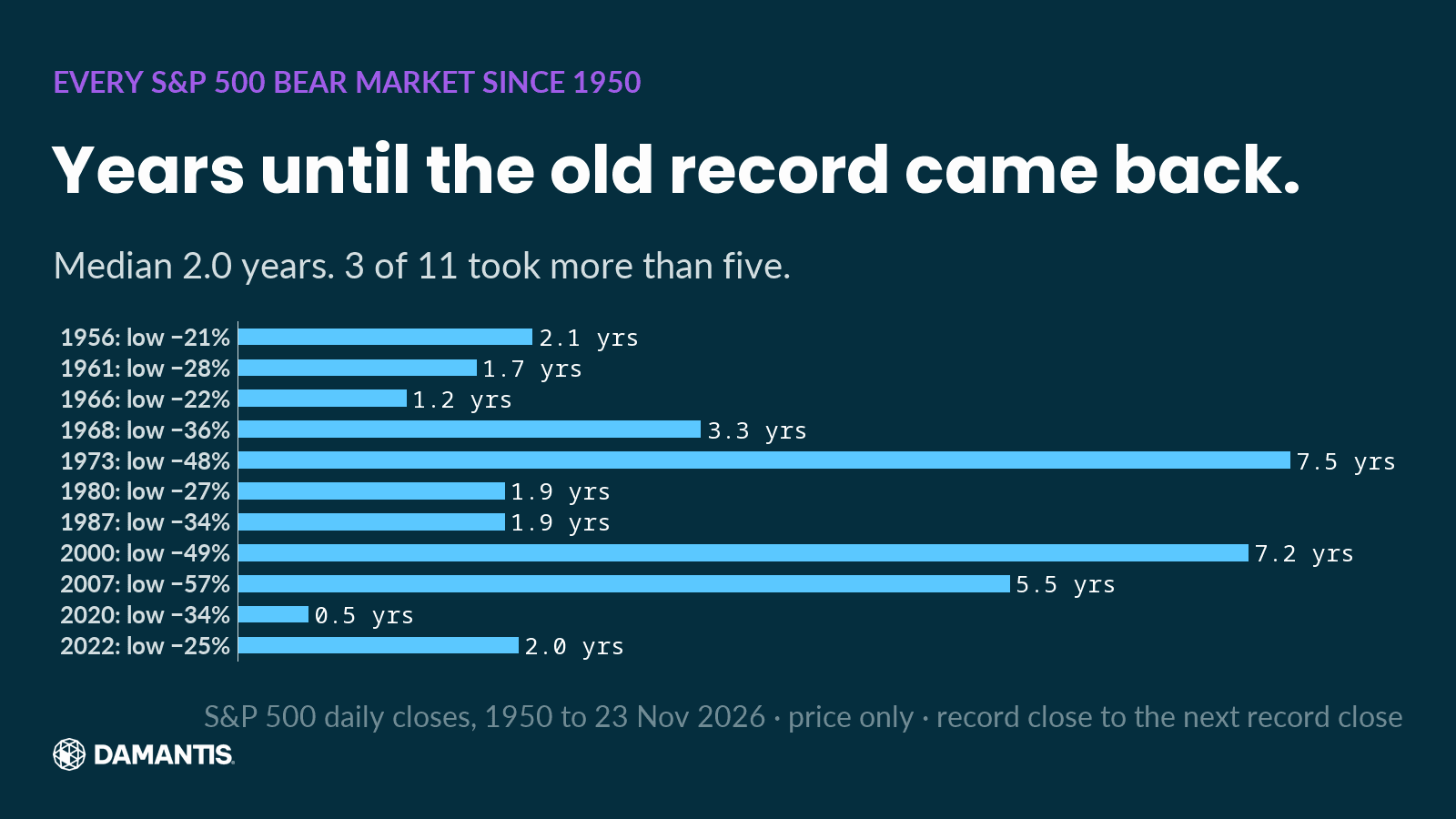
- Median wait: 2.0 years from the record to the next record.
- Shortest: 0.5 years, after the 2020 record.
- Longest: 7.5 years, from the 1973 record to 1980.
- Within two years: 5 of 11.
- More than five years: 3 of 11, after the records of 1973, 2000 and 2007.
The three long waits were also the three deepest falls. 1973: down 48%, back in Jul 1980. 2000: down 49%, back in May 2007. 2007: down 57%, back in Mar 2013. All prices only, without dividends.
How long does it take to reach the bottom?
The fall itself is shorter than the wait. The median bear market took 15 months from the record to its lowest close.
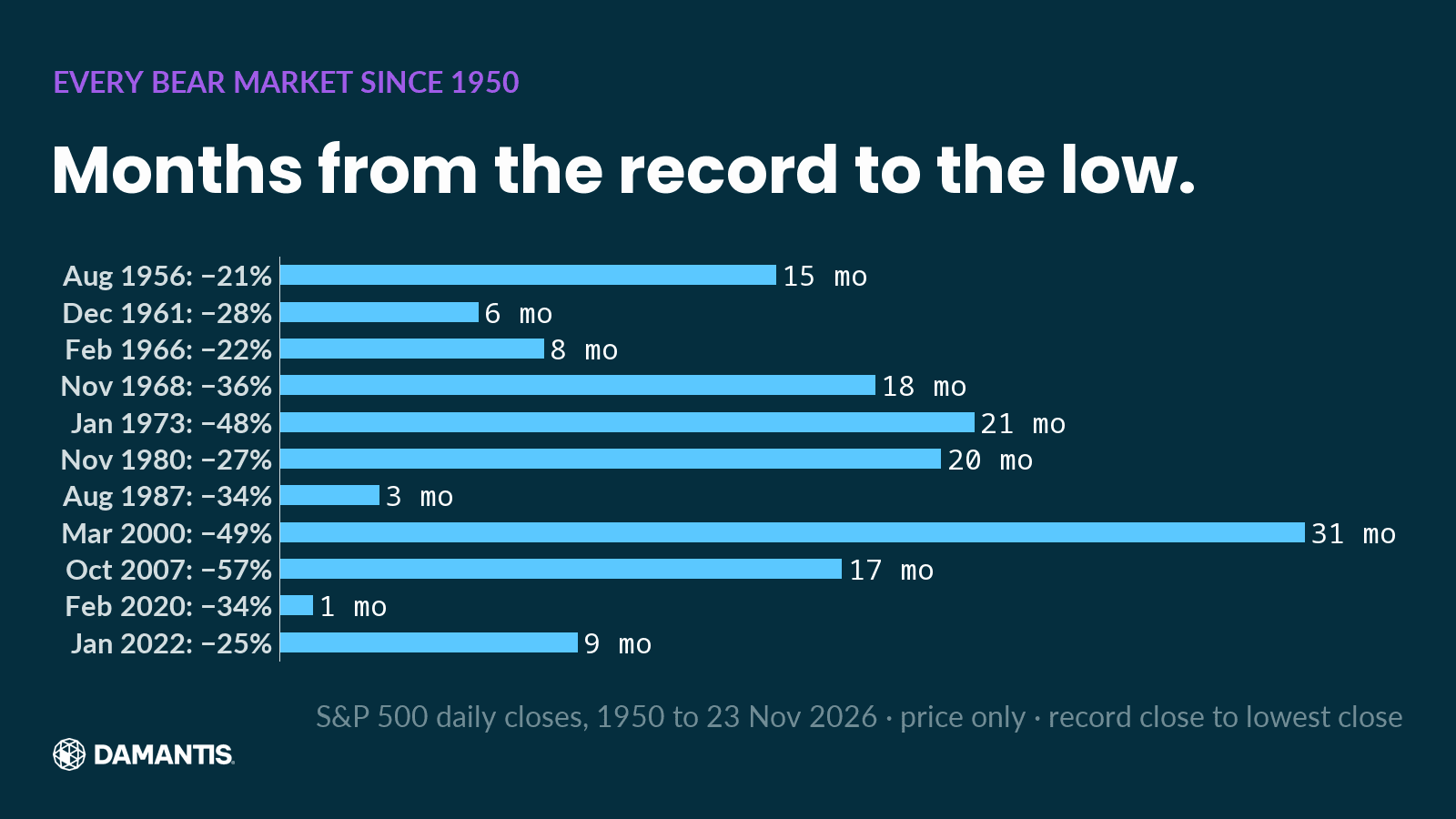
The range is wide. 1 month in 2020. 31 months after the 2000 record. And speed told you little about depth: the falls from 1987 and 2020 went more than 33% down and found their low within 3 months.
After the low, the climb back to the old record took a median 1.3 years more. That is the part most people forget to count. The low is not the end of the wait. It is the middle of it.
How often does a correction become a bear market?
A correction is a fall of 10% from the record. A bear market is 20%. Since 1950, the S&P 500 had 67 finished falls of 5% or more. 24 reached the 10% line. 11 of those went on to 20%.
So roughly half of all corrections stopped there and half became bear markets. Not a coin you want to flip with money you need in five years. At the first close below 10%, nobody could tell the two groups apart. By calendar year, a fall of 10% came in most years since 1928, as counted in how often does the stock market crash. They all started as a red week that looked like every other red week.
The deeper ones thin out quickly: 6 falls reached 30%, and 3 reached 40%. Those few are the ones that set the long waits above.
How long do Nasdaq bear markets last?
The Nasdaq-100 is a different story, and it is the one in the news this month. Since 1985 it first closed 20% below its record 8 times.
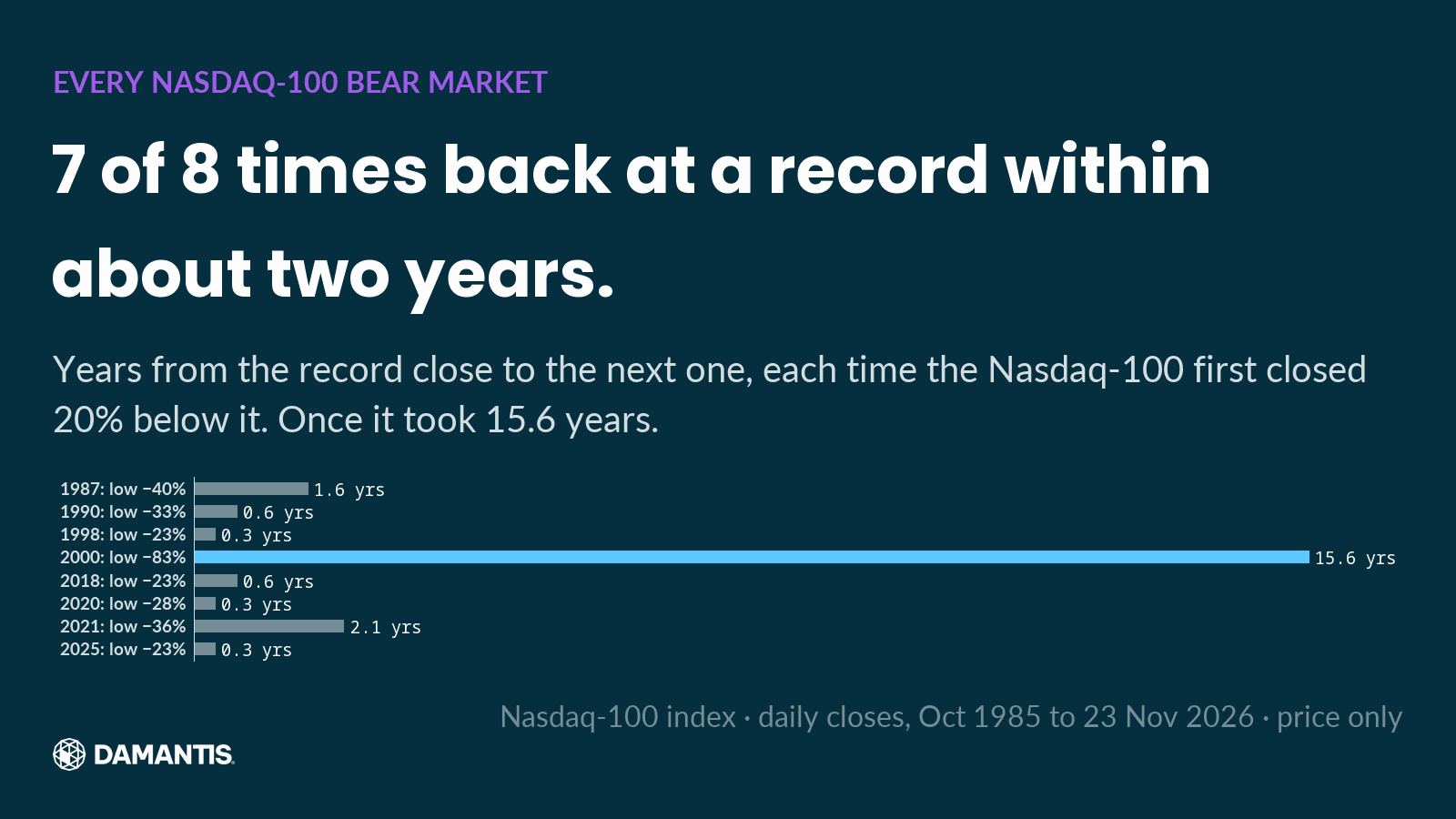
7 of 8 were back at a record within about two years. The median case took 0.6 years, faster than the S&P 500.
Then 2000. Down 83%, back in Nov 2015. 15.6 years. Someone who held the Nasdaq-100 from the March 2000 record waited longer than many people's whole run-up to retirement.
So which kind is this one?
On 23 Nov 2026, the last close we counted, the S&P 500 was 7% below its record close of 6 Oct 2026, 34 trading days later. That is between 5% and 10% below its record. Of the 67 finished falls since 1950 that got this far, 24 went on to 10% (36%). The Nasdaq-100 closed 14.3% below its record of 6 Oct 2026, short of the 20% line.
History, counted honestly, says most bear markets were short. Anyone who tells you this one will be short too is betting on the base rate. We are not.
We think the Nasdaq fall is the 2000 kind. Not because of the chart, which looks ordinary so far, but because of what sits inside the index: a handful of AI companies carrying most of it, and a money loop in which chip makers and cloud companies fund part of their own demand. We wrote that stand down on 8 November, we think AI is a bubble, and laid out the full Nasdaq count on 22 November in is the Nasdaq in a bear market.
We could be early. The count above shows how rarely the long kind came. It also shows what it cost when it did.
What does this mean 5 to 15 years before retirement?
A two-year wait is noise for a 30-year-old. A seven-year wait is not, if the money is meant for the years right after you stop working. What a fall like this does to a retirement account is counted in what happens to your 401k in a crash. What it did to $1 million taken out over 30 years is in is $1 million enough to retire?
The long waits in the S&P 500 record came after 1973, 2000 and 2007. Two of the three came after a long boom led by a few favourite stocks. In 1973 those were the "Nifty Fifty", in 2000 the internet leaders. Neither of those falls looked special in its first weeks.
Count the deeper falls too, every fall of 30% or more since 1927, and the range gets wider: 7 falls, from 6 months to 25 years until the old high came back.
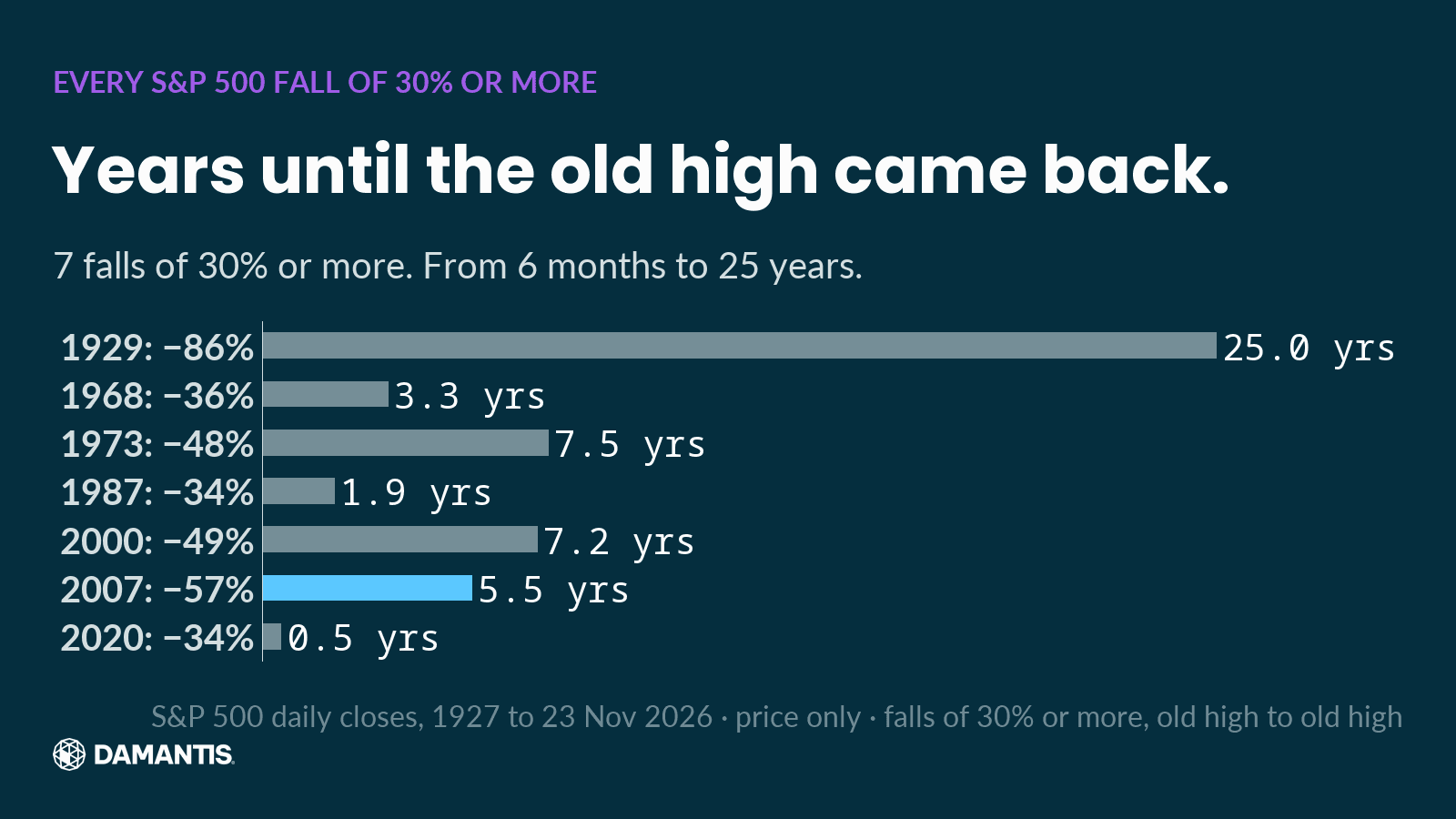
None of this tells anyone what to do with their own money. It is every bear market since 1950, so you can check it.
Frequently asked questions
How long do bear markets typically last?
The 11 S&P 500 bear markets since 1950 took a median 15 months from the record close to the low, and a median 2.0 years from the record to the next record, prices only.
How long did it take the stock market to recover after a crash?
The S&P 500 fell 30% or more 7 times since 1927. The way back to the old high took from 6 months, after the 2020 high, to 25 years, after the 1929 high. Prices only, without dividends.
How long did it take to recover from 2008?
The fall most people call 2008 started at the S&P 500 record of 2007. The index went 57% down and closed above that record again in Mar 2013, 5.5 years after it, prices only.
What was the longest wait for the stock market to recover?
Counted by the wait for the old high, the fall from the 1929 high: the S&P 500 went 86% down and needed 25 years, until 1954. Since 1950, the longest wait was 7.5 years, after the 1973 record. The Nasdaq-100 took 15.6 years after its March 2000 record, until Nov 2015.
How many bear markets came back within two years?
5 of 11 S&P 500 bear markets since 1950, and 7 of 8 Nasdaq-100 bear markets since 1985.
Is the stock market in a bear market now?
On 23 Nov 2026, the last close we counted, the S&P 500 was 7% below its record close of 6 Oct 2026, 34 trading days later. That is between 5% and 10% below its record. Of the 67 finished falls since 1950 that got this far, 24 went on to 10% (36%). The Nasdaq-100 closed 14.3% below its record on 23 Nov 2026, short of the 20% line.
When will the stock market recover?
Nobody can know. The count gives the range: from 0.5 to 7.5 years for the S&P 500 since 1950, from the record to the next record.
How DAMANTIS looks at this
Every chart in this article was computed from market data, with its source and date on the image. No figure was typed in by hand. Once a week we send the same kind of count for the whole US market: the Damantis Extremes Index, how many US stocks sit at extremes, against a normal week and the record. One email, no daily noise. Get the weekly email
Education, not investment advice.